PPARCセミナー (2026/1/16)

PPARCセミナー (2026/1/16)
(1)
[Name]
Haruki Okuda
[Title]
LAMPロケット搭載オーロラカメラにより観測された酸素原子844.6 nm発光高度の推定
[Abstract]
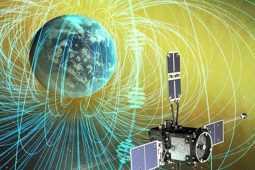
LAMPロケット実験では、粒子・電磁場・光学の同時観測により、脈動オーロラ(PsA)と降下電子、相対論的電子マイクロバーストの関係を調べる。本研究で用いるAIC2は、ロケットの磁気フットプリント近傍における発光を撮像するロケット搭載カメラである。AIC2のうちAIC-S2は酸素原子 844.6 nmを広視野で撮像でき、磁気フットプリントから地平線方向までを1枚の画像で覆える。このため、地平線方向の観測が成立すれば、視線の幾何から発光高度を絞り込めると期待される。
AIC2はデスパンテーブルに搭載され、ロケットのスピンを打ち消す向きに回転させることで、カメラの指向を一定に保つ設計であり、当初はAIC-S2を南西方向へ向ける計画だった。しかし、デスパンテーブルの予備実験動画と、AIC-S1の撮像データを比較したところ、テーブルが期待どおりに動作していないことが分かった。そこで解析では、スピン軸回りの位相を「AIC-S2が南西を向くように」定めるのではなく、AIC-S1の街明かりが実際の地理座標に一致するように決定した。同じ位相をAIC-S2にも適用した結果、オーロラ発光のピークが地平線とほぼ水平に現れた。さらに、AIC-S2のマップ化結果を地上全天カメラ(THEMIS)と比較したところ、整合的な結果が得られた。今後は、844.6 nm発光の高度プロファイルを作成し、先行研究モデルと組み合わせて降下電子のエネルギー推定へつなげたい。本発表では、そのための解析の流れと現段階の結果を示す。
(2)
[Name]
Takeru Katou
[Title]
Cassini 探査機 flyby (T77) 時の土星電波掩蔽を用いた Titan 電離圏密度構造:予備解析
[Abstract]
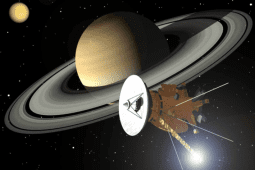
土星系最大の衛星タイタンは、太陽系内の衛星で唯一、分厚い大気を有している。その中性大気は主に窒素から成るが、メタンや炭化水素も含む。また、その電離圏は50種以上のイオンが分子やエアロゾルの生成に寄与するなど、太陽系で最も複雑な組成を持つとされる。本研究では、Yasuda et al. [年号] によって確立された惑星電波掩蔽法を用い、タイタンの電離圏電子密度構造の推定を行う。解析にはCassini探査機のRPWI(電波・プラズマ波動観測器)によって観測された土星電波データを用いる。具体的には、土星電波がタイタンに掩蔽されるイベント前後のデータを解析し、電離圏による屈折の影響を受けた電波から掩蔽の開始・終了時刻を算出する。さらに、EXPRESコードを用いて土星電波源からの伝搬経路を計算し、ガウス関数型の電離圏モデルを用いたレイトレーシング・シミュレーションを実施する。観測から得られた掩蔽時刻とシミュレーション結果を比較することでモデルの最適化を行い、電離圏構造を決定する。本発表では、全127回のフライバイのうち、T77フライバイ(77回目)に着目した解析結果について報告する。
Abstract: Titan, Saturn’s largest moon, is the only satellite in the solar system to possess a thick atmosphere. While its neutral atmosphere is primarily composed of nitrogen, it also contains methane and hydrocarbons. Its ionosphere is considered the most chemically complex in the solar system, with over 50 types of ions contributing to the formation of molecules and aerosols.In this study, we estimate the electron density structure of Titan’s ionosphere using the planetary radio occultation method established by Yasuda et al. We analyzed Saturnian radio wave data obtained by the Radio and Plasma Wave Science (RPWI) instrument onboard the Cassini spacecraft. Specifically, we examined data around occultation events where Saturnian radio waves passed behind Titan, calculating the start and end times of the occultation based on the refraction caused by the ionosphere.Furthermore, we performed ray-tracing simulations using a Gaussian ionospheric model, with propagation paths from the radio source calculated via the EXPRES code. By comparing the observed occultation times with the simulation results, we optimized the model to determine the ionospheric structure. This presentation provides an interim report focusing on the analysis of the T77 flyby out of the 127 total flybys.
(3)
[Name]
Ayuto Kawakami
[Title]
Estimating the potential for passive radio sounding of icy moons from radar equation and ray tracing
[Abstract]
passive radarとは、自ら電波を放射して反射波を観測するactive radarと異なり、自然電波が反射したものを捉えて観測する探査手法である。
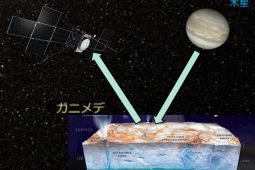
RIMEやREASONが行う予定であるpassive radar探査において、木星電波を用いたガニメデの探査を想定した、探査機の木星天頂角に対する表面反射波の受信強度の推定をKumamoto 2025の資料に記載のレーダー方程式をもとに行った。
その結果、同資料で想定されていた受信強度より20dB程度低い計算結果が導かれた。そのうえ、記載のレーダー方程式について、立体角による減衰の有無やFresnel zoneの扱いなど、不明瞭な点が露呈したため、関係する論文を確認し、衛星表面の荒さの表現の方法など、計算原理の確認を行った。一般的なレーダー方程式はPassive radarにおいてはそのまま使えず、改良が必要であろうことが導かれた。
また、木星電波放射のray tracingを行い、完全球面を仮定した衛星表面で反射した際の反射角の分布を探査機の高度別に行った。y=0と固定した円筒面について、探査機が夜側に抜けていくにつれ受信強度が減少することを確認し、yに幅を持たせた球体についても緯度方向と経度方向の角度の分布を描画した。
加えて、立体角あたりの本数にするため補正を行い、入射角や衛星表面の誘電率による電波の反射率について、TEモード、TMモードやそれらの平均について計算し、描画を行うなど、実際の状況に近い形で推定を行えるような準備をした。
このセミナーでは、これらの研究の進捗と、これからの展望について述べる。
Passive radar is the sensing method that captures and observes reflected natural waves, different from Active radar, which emits its own radio waves and observes reflected signal. First, For passive radar exploration planned by RIME and REASON, I estimated the received signal strength of surface-reflected waves as a function of the spacecraft’s Jupiter zenith angle, assuming exploration of Ganymede using Jupiter’s radio emissions, based on the radar equation described in the Kumamoto 2025 materials. As a result, the calculated signal strength was approximately 20 dB lower than that assumed in the materials. Furthermore, unclear points in the described radar equation were revealed, such as the presence or absence of attenuation due to solid angle and the treatment of the Fresnel zone. Therefore, I reviewed related papers and verified the calculation principles, including methods for representing satellite surface roughness. It was concluded that the general radar equation cannot be directly applied to passive radar and requires modification. Additionally, I performed ray tracing of Jupiter’s radio emissions and calculated the distribution of reflection angles when reflected off a satellite surface assumed to be a perfect sphere, at various spacecraft altitudes. For a cylindrical surface fixed at y=0, I confirmed that the received signal strength decreases as the spacecraft moves toward the night side, and for a sphere with a range in y, I also plotted the angular distributions in both the latitude and longitude directions. Furthermore, I made corrections to normalize by solid angle and calculated and plotted the radio wave reflectance based on the incident angle and satellite surface permittivity for TE mode, TM mode, and their average, preparing for estimations that more closely approximate actual conditions. In this seminar, I present the progress of these studies and future prospects.
(4)
[Name]
Hiroshige Yamaguchi
[Title]
飯舘電波望遠鏡の低周波広帯域フィードアンテナの開発
Development of a Low-Frequency Broadband Feed Antenna for the IPRT
[Abstract]
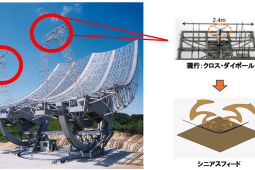
PPARCで運用している飯舘惑星電波望遠鏡(IPRT)では現在、観測の広帯域化および高感度化を目指し、新しい受信機の開発を行っている。
現行のIPRT受信系は、325MHz(および開発中の650MHz)を中心とした狭帯域高感度観測に加え、100-500MHz帯をターゲットとした広帯域太陽電波スペクトル観測システムを独立して備えている。しかし、後者の広帯域システムにおいては開口能率が平均20%程度にとどまり、十分な感度が得られていないという課題があった。
そこで本研究では、広帯域かつ高感度化が可能な角錐型sinuousアンテナの導入を決定し、以下の2点を目標に設計を開始した。
①100MHz〜700MHzの帯域において、平均40%まで開口能率を引き上げる。
②主要観測周波数である325MHzおよび625MHzにおいて、60%の開口能率を達成する。
これまでに、電磁界シミュレーションソフトFEKOを用いたアンテナ設計と、それに基づく1/5スケール実機を用いた電波暗室での遠方界測定を実施した。本セミナーでは、これらの開発の現状と今後の見通しについて紹介する。
The Iidate Planetary Radio Telescope (IPRT), operated by PPARC, is currently developing a new receiver aimed at achieving wider bandwidth and higher sensitivity for observations.
The current IPRT receiving system is equipped with an independent broadband solar radio spectral observation system targeting the 100–500 MHz band, in addition to narrowband high-sensitivity observations centered at 325 MHz (and 650 MHz, currently under development). However, the broadband system faces a challenge regarding aperture efficiency, which remains at an average of approximately 20%, resulting in insufficient sensitivity.
Therefore, in this study, we decided to introduce a pyramidal sinuous antenna capable of achieving both wide bandwidth and high sensitivity, and initiated the design with the following two goals:
1. To increase the aperture efficiency to an average of 40% in the 100–700 MHz band.
2. To achieve an aperture efficiency of 60% at the primary observation frequencies of 325 MHz and 625 MHz.
To date, we have conducted antenna design using the electromagnetic simulation software FEKO and performed far-field measurements in an anechoic chamber using a 1/5 scale model. In this seminar, we will present the current status of development and future prospects.