PPARCセミナー (2025/12/19)

PPARCセミナー (2025/12/19)
(1)
[Name]
Ayuto Kawakami
[Title]
Estimate of Received Signal Strength and Verification of Reflection Angle Distribution in Passive Radar
[Abstract]
Passive radar is the sensing method that captures and observes reflected natural waves, different from Active radar, which emits its own radio waves and observes reflected signal. First, based on materials from Kumamoto 2025, I estimated the strength of reflected signal, relative to the spacecraft’s Jovian zenith angle for a hypothetical exploration of Ganymede using Jupiter’s radio waves. It is planned by RIME, for example. The results indicated that it was able to reproduce the pattern of radio wave intensity attenuation that occurs as the optical path length changes with the zenith angle, but a calculated signal strength is approximately 20 dB lower than that assumed in the Kumamoto 2025 estimation. From this, it was determined that it is necessary to reassess of the calculation principles, including the presence or absence of attenuation due to solid angle and the treatment of the Fresnel zone. This led to a change in approach, involving the review of the relevant papers. Additionally, I carried out ray tracing of Jupiter’s radio emissions to determine the distribution of reflection angle when reflected off a satellite surface assumed to be a perfect sphere, varying by probe altitude. For y=0 fixed: it is considered a cylindrical surface. it was confirmed that the received signal strength decreases as the probe moves toward the night side. With a range in y: treated as spherical surface on the other hand, I plotted the angular distributions in both the latitude and longitude. In this seminar, I present the progress of these studies and future prospects.
(2)
[Name]
Hiroshige Yamaguchi
[Title]
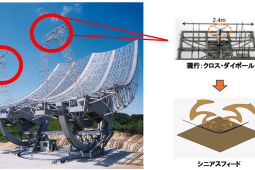
Development of a Low-Frequency Broadband Antenna for the IPRT
[Abstract]
PPARCで運用している飯舘惑星電波望遠鏡(IPRT)では現在、観測の広帯域化および高感度化を目指し、新しい受信機の開発を行っている。
現行のIPRT受信系は、325MHz(および開発中の650MHz)を中心とした狭帯域高感度観測に加え、100-500MHz帯をターゲットとした広帯域太陽電波スペクトル観測システムを独立して備えている。しかし、後者の広帯域システムにおいては開口能率が平均20%程度にとどまり、十分な感度が得られていないという課題があった。
そこで本研究では、広帯域かつ高感度化が可能な角錐型sinuousアンテナの導入を決定し、以下の2点を目標に設計を開始した。
①100MHz〜700MHzの帯域において、平均40%まで開口能率を引き上げる。
②主要観測周波数である325MHzおよび625MHzにおいて、60%の開口能率を達成する。
これまでに、電磁界シミュレーションソフトFEKOを用いたアンテナ設計と、それに基づく1/5スケール実機を用いた電波暗室での遠方界測定を実施した。本セミナーでは、これらの開発の現状と今後の見通しについて紹介する。
The Iidate Planetary Radio Telescope (IPRT), operated by PPARC, is currently developing a new receiver aimed at achieving wider bandwidth and higher sensitivity for observations.
The current IPRT receiving system is equipped with an independent broadband solar radio spectral observation system targeting the 100–500 MHz band, in addition to narrowband high-sensitivity observations centered at 325 MHz (and 650 MHz, currently under development). However, the broadband system faces a challenge regarding aperture efficiency, which remains at an average of approximately 20%, resulting in insufficient sensitivity.
Therefore, in this study, we decided to introduce a pyramidal sinuous antenna capable of achieving both wide bandwidth and high sensitivity, and initiated the design with the following two goals:
1. To increase the aperture efficiency to an average of 40% in the 100–700 MHz band.
2. To achieve an aperture efficiency of 60% at the primary observation frequencies of 325 MHz and 625 MHz.
To date, we have conducted antenna design using the electromagnetic simulation software FEKO and performed far-field measurements in an anechoic chamber using a 1/5 scale model. In this seminar, we will present the current status of development and future prospects.