Saturn

Estimates of Titan’s ionospheric density have predominantly relied on in-situ measurements from the Cassini spacecraft, which concluded its mission in 2017. Consequently, these data suffer from limited spatial and temporal coverage. This study introduces a novel approach to density estimation by utilizing Saturnian auroral radio emissions that have traversed Titan’s ionosphere. By characterizing density structures in regions and time intervals previously inaccessible, we aim to conduct a comprehensive statistical analysis of the impacts of solar extreme ultraviolet (EUV) radiation and Saturn’s magnetospheric plasma. This will ultimately help elucidate the full picture of Titan’s atmospheric environment. Currently, our analysis is focused on the 77th Titan flyby (T77), from which we anticipate deriving at least 30 sets of density estimates.(Written by KATO Takeru.)
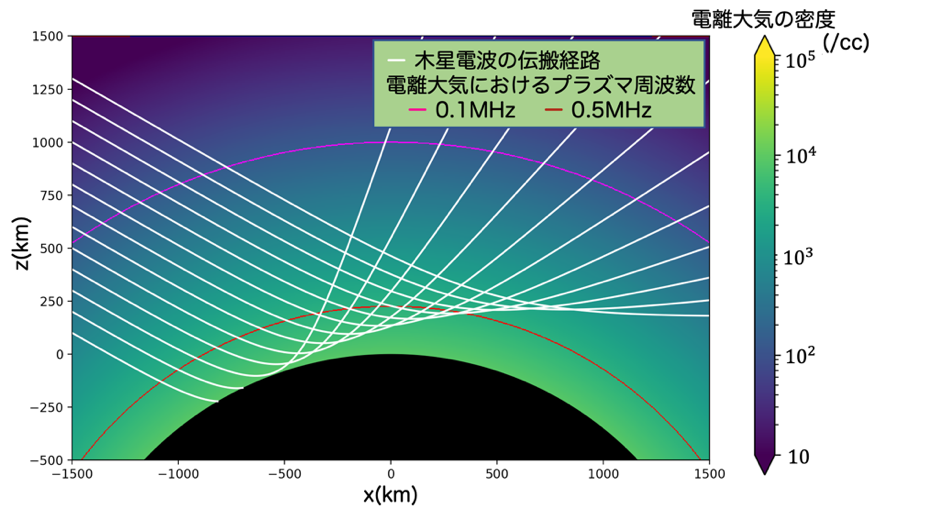
In this study, we focus on the refraction of planetary radio emissions as they pass through the ionospheres of moons—electrically charged layers of the atmosphere—and develop a method to derive electron densities from their bending behavior. Conventional observation techniques have limitations in spatial coverage. To address this, we propose a new approach that simulates the radio wave paths through the ionospheres using computer-based ray tracing and inversely estimates the electron density. We are currently applying this method to derive the electron density distribution of Titan’s ionosphere using data from the Cassini spacecraft. Furthermore, in preparation for the upcoming JUICE mission, we are investigating the use of radio wave polarization (i.e., rotational direction) to improve the accuracy of the analysis. Written by YASUDA Rikuto.